
VibraTech
Master vibration. Perfect the ride.
Origins
“My hands go numb and it’s hard to ride. I tried modifying my bar ends myself, and it helped a little, but it didn’t fix the problem. Could AELLA make something better?” That is how VibraTech began, about six months before the product launch.
Our manufacturing engineers explored whether the materials and machining techniques behind our existing engine mount washers and cylinder head washers could be applied, testing many combinations of materials and shapes.
Only titanium alloy produced a clearly different result: the vibration people find unpleasant was distinctly reduced. You can notice it from engine start through idle, and even more clearly once you start riding.
Building on this finding, we further refined the machining method and size, and created the Handlebar End Damping Washer, which delivers a consistent effect at the smallest possible size.
Concept
VibraTech suppresses and controls vibration to reduce what riders feel as discomfort. At the engine mounts, it damps the fine engine vibrations transmitted to the frame, which not only reduces vibration but also lets the engine rev more smoothly.
Vibration naturally differs greatly between idling and riding, but the measured waveform also changes with the measurement point, the bike’s angle at rest, and road conditions. Accurate visualization is therefore essential, and it records the undeniable facts.
VibraTech overturns the long-accepted belief that vibration is simply part of riding, focusing instead on letting riders comfortably control the true performance of their motorcycle. It reminds us that better concentration and greater safety matter most in discovering the deeper joy of riding.
Titanium alloys on the market range from cheap to expensive, even when they claim to be the same grade. Expensive alloys generally meet their specifications, while cheap ones can fail before reaching them and, in the worst case, even fracture, so motorcycle parts demand particular care. Although it costs more, AELLA uses only Japanese-made titanium alloy.
VibraTech Products
Click a product image below to visit our online shop.
* Results are based on a text search, so some unrelated products may appear in the list.
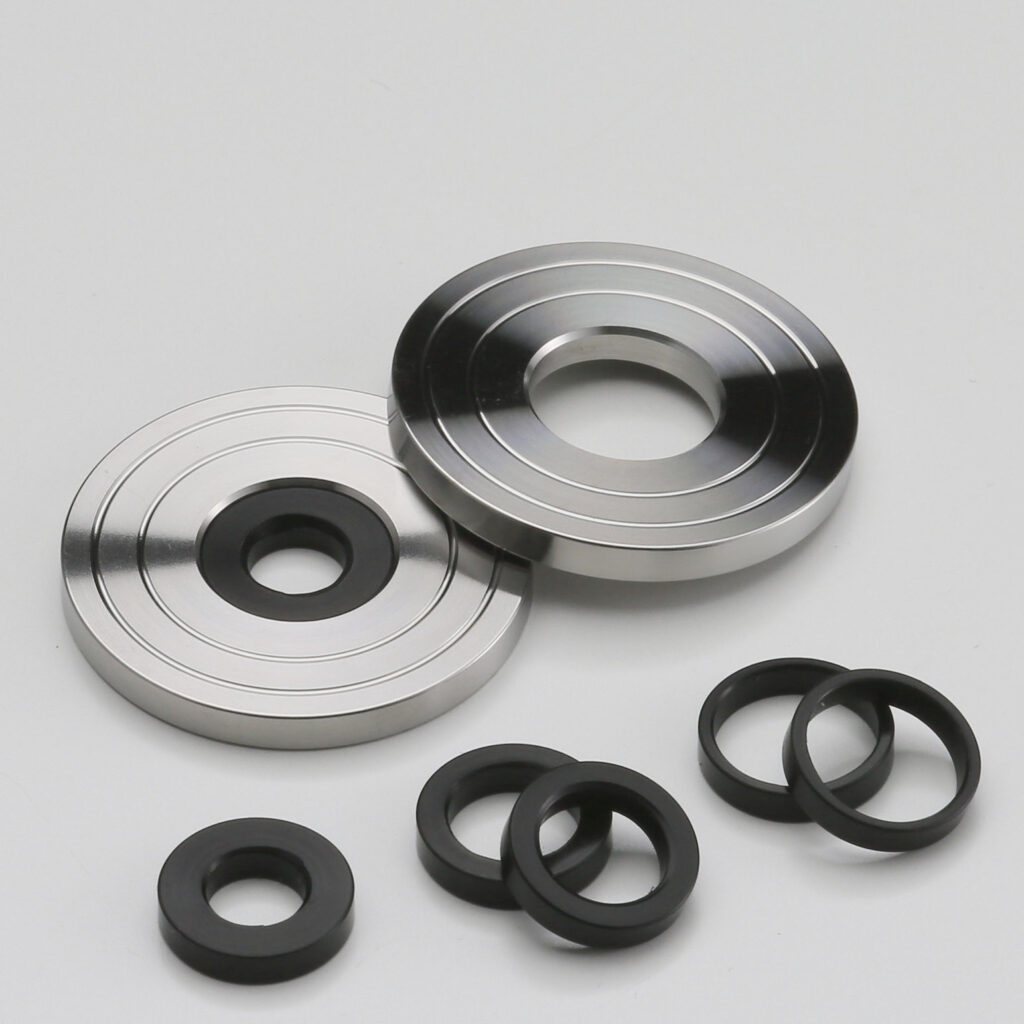
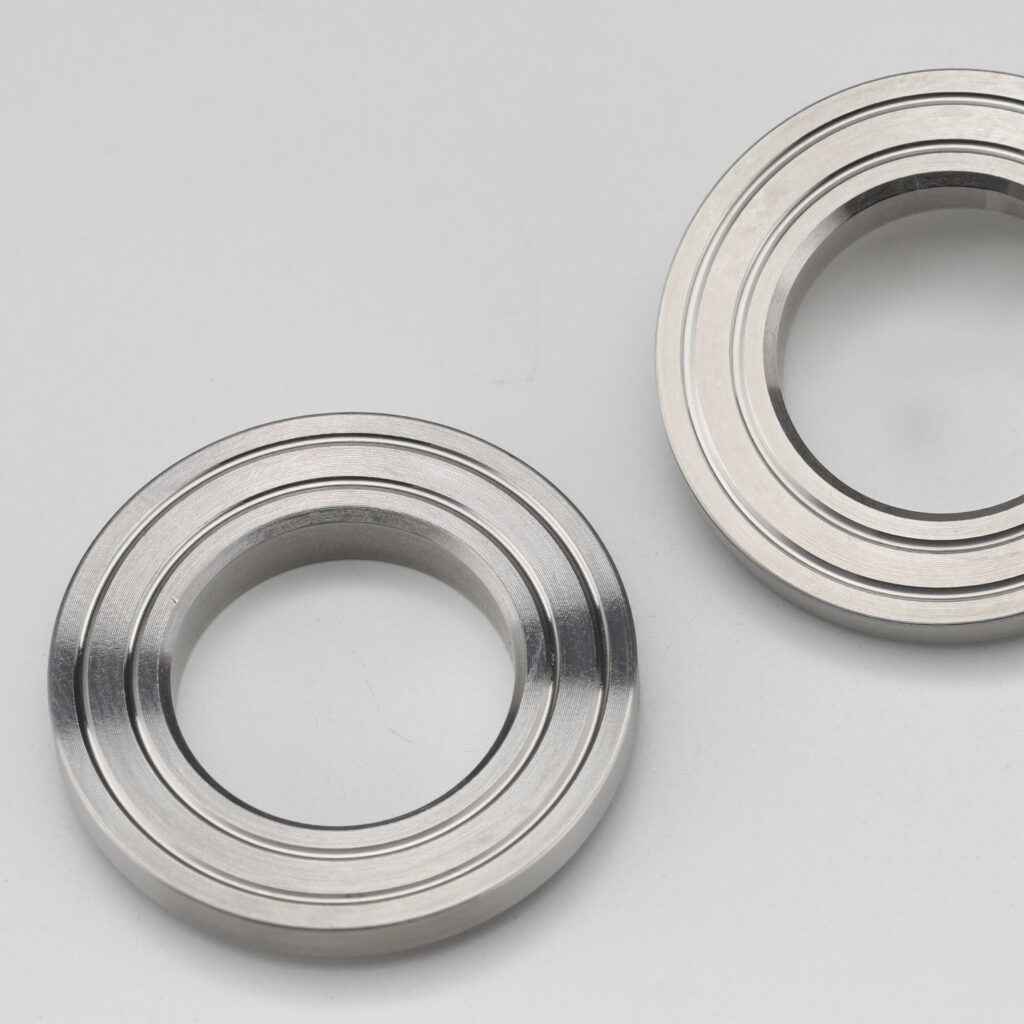
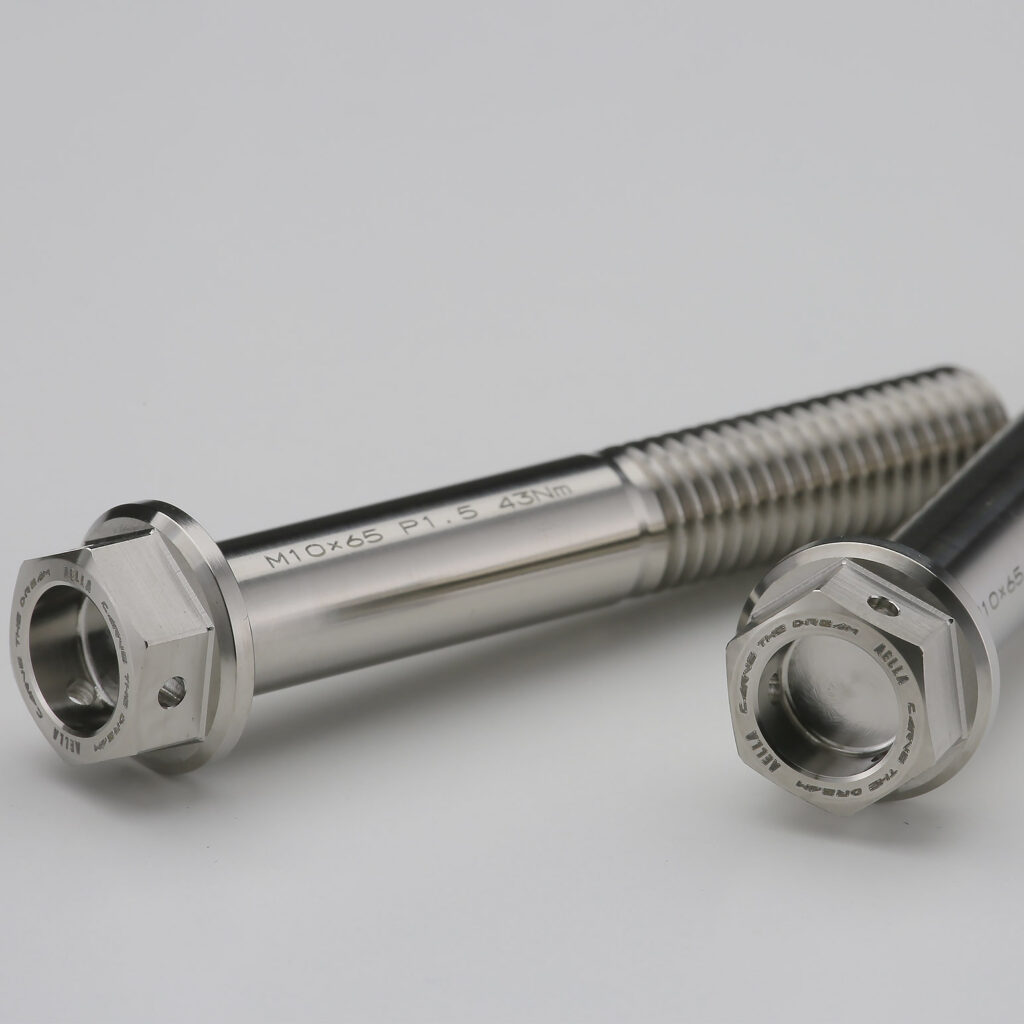
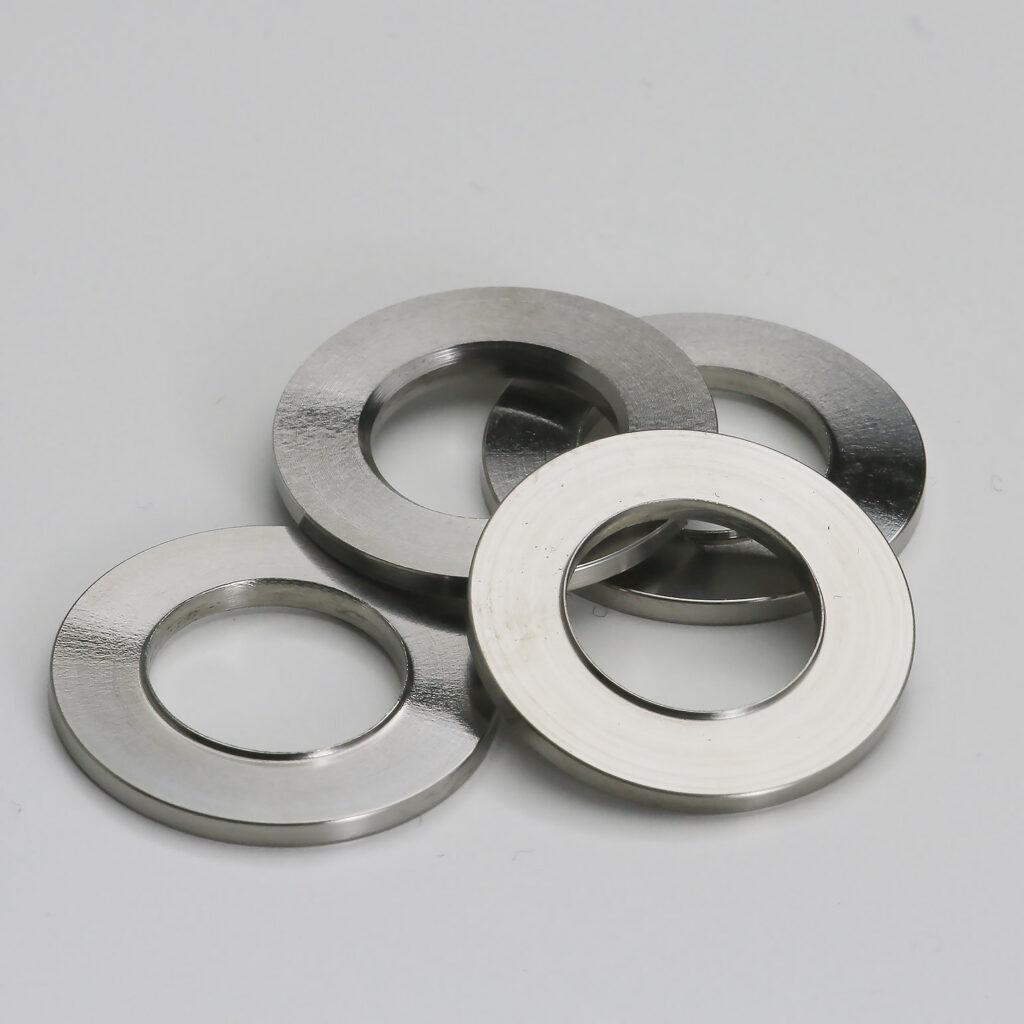
Washer
Product Features
| Product | Effects & Features |
|---|---|
| Handlebar End Washer | Reduces the hand numbness that comes with long rides. |
| Engine Mount Washer | Reduces noise-level vibration from the engine. By lowering friction loss in engine rotation, it reduces vibration while also improving engine feel. |
| Caliper Bolt | Reduces the fine vibrations generated under braking, giving clearer feedback to your hands. Machining also improves fastening precision for brakes that bite deep with a firm feel. |
| Caliper Mount Washer | A self-alignment function that centers the bolt reduces brake drag while improving initial brake feel. |
About VibraTech Vibration Data
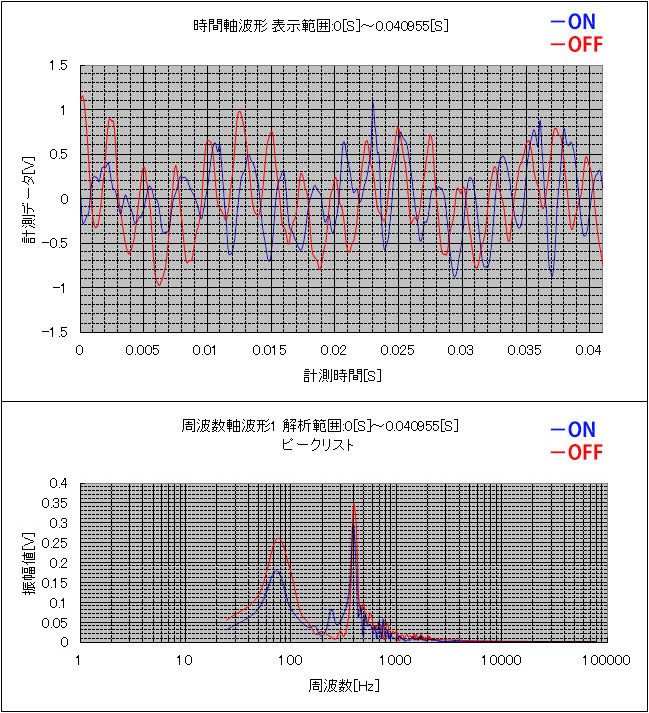
Measurements use our own in-house method: a motor generating constant vibration was attached to the handlebar, comparing results with and without the damping washer. A magnetic probe was used; because readings are not perfectly constant, slight differences in amplitude appear along the time axis.
Besides the time axis, we also measured which frequency ranges were vibrating. The results show large amplitudes around 80 Hz and 400 Hz, with the VibraTech damping washer lowering the peak values.
About Titanium
Commonly called “64 titanium” in Japan, this alloy is designated JIS Class 60 / TAB6400 under JIS and ASTM B348 Gr5 under the American ASTM standard.
It is also written as Ti-6Al-4V, which states its chemical composition: 6% aluminum (Al) and 4% vanadium (V) by mass.
Titanium is light, corrosion-resistant, and strong,
making it a star material in aviation, where it is said that “titanium alloys were developed alongside the aircraft.”
Titanium alloys are said to make up 25% of the airframe of the F-15 fighter, and 40% of the F-22.
Titanium’s metallic structure has two phases: the α phase (hexagonal close-packed) and the β phase (body-centered cubic).
Pure titanium is α phase at room temperature, while 6-4 alloy is an α-β alloy containing both phases.
More precisely, there are also intermediate types: near-α alloys, which lie on the α side of α+β alloys, plus near-β alloys, which lie on the β side.
Near-α alloys are mostly α phase at room temperature; likewise, near-β alloys are mostly β phase.
Near-α alloys such as Ti-8Al-1Mo-1V offer excellent creep resistance and high-temperature strength.
Near-β alloys such as Ti-10V-2Fe-3Al can achieve high strength through heat treatment.
Physical Properties of Titanium
| Property | Value |
|---|---|
| Melting point | 1,668°C |
| Density | 4.51 (g/cm3) |
| Atomic number | 22 |
| Electrical resistivity | 47–55 (μΩ·cm, 20°C) |
| Electrical conductivity | 3.1 (% relative to Cu) |
| Coefficient of linear expansion | 8.4×10⁻⁶(cm/cm/°C, 0–100°C) |
| Specific heat | 0.12 (cal/g/°C) |
| Magnetic permeability | 1.0001 |
| Young’s modulus | 10.64×10⁴N/mm2 |
Titanium Characteristics by Microstructure
| Type | Standard / Equivalent Grade | Characteristics |
|---|---|---|
| α alloy | 5Al-2.5Sn, etc. | Not as strong as 64 alloy, but offers stable strength from low to high temperatures. |
| α-β alloy | JIS Class 60 (64 alloy), etc. | Excellent strength, but hard to machine or bend, which tends to lower yield. |
| β alloy | Ti-15-3-3-3 alloy, etc. | Strength equal to or greater than 64 alloy, with excellent cold-rolling properties plus better workability than 64 alloy. |
[Vickers Hardness and Specific Strength] t: plate thickness (mm)
| Material | Vickers hardness (HV) | Specific strength (N·m/kg) |
|---|---|---|
| α-β alloy | 320 | ≤202 |
| Steel T5 (SS400) | 130 | 51–65 |
| Stainless steel (SUS304) | 180 | ≤66 |
| Aluminum alloy (A7075-T6) | 160 | ≤193 |
| Magnesium alloy | 70 | ≤123 |
Titanium at a Glance
- By weight, it is about 3 times as strong as aluminum and about 2 times as strong as iron.
- With a specific gravity (density) of 4.51, it weighs about half as much as copper and about 60% as much as iron.
- While high-specific-strength aluminum alloys lose strength rapidly at around 200°C, titanium alloys outperform even stainless steel in mechanical strength up to 500°C.
Aircraft engine makers such as Rolls-Royce choose this material not only for the specific strength that saves weight, but also for this heat resistance. - It forms a passive film that gives it excellent corrosion resistance. Its seawater resistance rivals platinum, and being fully corrosion-proof, it is used in equipment such as submersibles.
- With a Young’s modulus about 50% that of stainless steel, it is highly resistant to bending, and its springback force when bent is 2–3 times that of stainless steel.
- Its thermal expansion coefficient is 70% of iron’s and 36% of aluminum alloy (A7075)’s, and its thermal conductivity is 27% of iron’s and 14% of A7075’s, far lower than other metals.